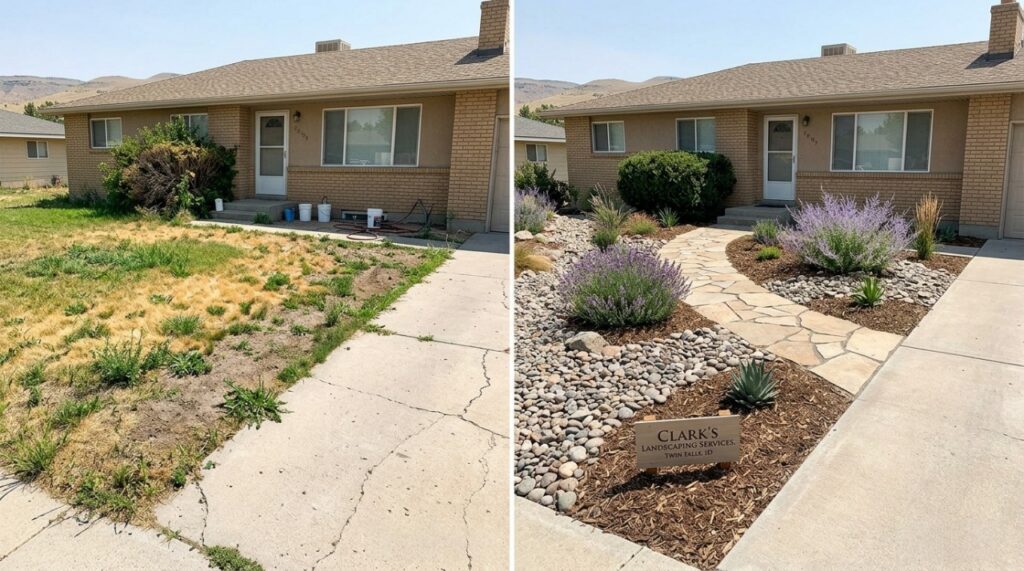
You walked the yard this morning and something’s off. Maybe the grass has bare patches that weren’t there last spring, the beds look tired, or water pools near the foundation after every rain. If you’re searching for residential landscaping services in Twin Falls, you’re probably past the point of wondering whether to call someone. The question is what’s actually wrong, what it’ll take to fix, and who can give you a straight answer. We’ve spent two decades on properties across this county, and most of what homeowners describe as “the lawn looks bad” turns out to be three or four small issues stacked on top of each other. This page walks through what we usually find and how we handle it.
What That Problem Usually Means
When a yard starts looking rough, the visible symptom is rarely the actual cause. Bare turf isn’t always a lawn problem. Drooping shrubs aren’t always a watering problem. Soggy spots aren’t always a drainage problem. In our experience working properties across Twin Falls County, the visible issue is usually downstream of something else entirely.
The most common root causes we run into:
- Irrigation coverage gaps or broken heads creating dry zones the homeowner blames on the grass
- Compacted soil from years of foot traffic, equipment, or original construction backfill
- Improper grading near the foundation that sends water the wrong direction
- Overgrown plant material competing for light, water, and root space
- Mulch beds that have built up too high against trunks and siding
None of these get better on their own. A few of them get noticeably worse each season. For homeowners who want to read up on water-wise plant choices that actually hold up in our climate, the University of Idaho Extension landscape and horticulture program is a solid starting point before you commit to a redesign. The first job of any decent landscaper is figuring out which root cause is actually driving the symptom before recommending work.
Warning Signs Homeowners Miss
Most people call us when the yard already looks bad. The signs that come earlier, the ones that would have saved real money if caught sooner, get missed because they don’t look like emergencies.
Watch for moss creeping into the lawn on the north side of the house. That’s almost always a sign of compaction plus shade plus moisture, and it spreads. Watch for grass that stays flat after you walk on it instead of springing back, which usually means the root zone has hit the wilting point even though the surface looks fine. Watch for mulch that’s pulled away from bed edges or piled into corners after wind, because that tells you the bed depth is wrong or the edging has failed.
The one most homeowners completely overlook is volcano mulching around tree trunks. We see it on probably half the properties we walk for the first time. Mulch piled against the bark holds moisture against the trunk, invites rodents, and causes girdling roots that slowly strangle the tree. By the time the canopy thins out and you notice, you’re often three or four years past the point where simply pulling the mulch back would have saved it. Delay on something like that turns a five-minute fix into a tree removal.
How We Handle Residential Landscaping Services in Twin Falls
Our process starts with a walk. Before anything else, we want to see the property, listen to what the homeowner has noticed, and look at the things they haven’t. We check the irrigation while it’s running if we can, look at how water moves across the property, probe the soil in a few spots, and assess the health of existing plant material.
From there we put together a plan that addresses the actual problem, not just the symptom. That might mean a full design and install on a new build, or it might mean targeted repair work on a yard that just needs the right three things fixed. Many of these projects pair naturally with our lawn care services in Twin Falls, since the same crew is already on the property and the work compounds. We talk through the plan with the homeowner before we quote, because a plan you don’t understand is a plan that creates conflict later.
One pattern we’ve seen on nearly every property where the original install was done without a slope check: the beds drain toward the house instead of away from it. The homeowner thinks they have a drainage problem and asks for more gravel or a French drain. The actual fix is regrading the bed back to a positive slope away from the foundation, usually around two percent. More mulch on top of bad grading just hides the problem until the basement finds it. We’d rather tell you that on day one than come back in two years to fix water damage.
“Austin and his crew transformed our backyard from a patchy mess into something we actually want to spend time in. They figured out the irrigation issue we’d been chasing for two summers and fixed the grading along the back fence. Honest pricing, showed up when they said they would.”
Aaron O., Twin Falls
What Affects Cost and Scope
Pricing on landscape work varies more than people expect because no two properties are the same. The biggest cost drivers are property size, access for equipment, depth of repair, material selection, and whether existing systems like irrigation or drainage need to be rebuilt or just adjusted.
A small front-yard refresh with new mulch, edging, and a few replacement shrubs is a different job than a full backyard renovation with grading, sod, irrigation, and hardscape. Soil conditions matter too. We hit a lot of caliche and compacted fill across this area, and breaking that up adds time. Tight side-yard access where we can’t get a skid steer through changes the labor math significantly.
Material choice also moves the number. Irrigation components built to Irrigation Association industry standards and best practices cost more upfront than the cheapest residential parts on the shelf, but they don’t fail in year three the way budget components do. We’ll lay out the tradeoff when it matters and let you decide.
Any estimate requires an on-site assessment. We do not quote landscaping work from photos, descriptions, or phone calls alone. There are too many variables we need to see in person, and a number we throw out without walking the property is a number that’s almost always wrong by the time we get there.
“Reliable, professional, and they take pride in the work. Our yard has never looked better and the irrigation finally works the way it should.”
Namttack M., Twin Falls
Why Homeowners Choose Clark’s Landscaping Services
We’ve been doing residential landscaping services in Twin Falls for 20 years, working out of our shop at 3818 2500 E. That’s long enough to be back on properties we originally serviced more than a decade ago, watching how plant choices and grading decisions held up. It’s also long enough to know what doesn’t work in our soil and our winters.
What homeowners tell us they appreciate is straightforward communication. We tell you what we see, what we’d recommend, and what the tradeoffs are. If a cheaper approach will get you most of the way there, we’ll say so. If the cheap fix is going to fail in two seasons, we’ll say that too. When a project also calls for irrigation services in Twin Falls, we coordinate that work alongside the landscape build so the system is sized correctly for the new plant zones from day one.
We also stay reachable after the job is done. If something settles, a head clogs, or you have a question about watering schedules a month later, you call the same number you called the first time.
“We’ve used Clark’s twice now, once for a full backyard redo and once for spring cleanup. Austin walks the property with you, explains what he’s seeing, and his crew does what they say they’re going to do. Rare to find that combination.”
Chris H., Twin Falls
Local Service FAQs
When is the best time of year to schedule landscaping work?
Spring and fall are the heaviest seasons for residential landscaping services in Twin Falls because soil temperatures and moisture levels favor planting and grading. That said, hardscape, drainage, and design work can run most of the year. We schedule based on the type of work and current ground conditions.
Do you handle one-time projects or only ongoing maintenance?
Both. We take on full installs, renovations, and one-time repairs, and we also offer recurring maintenance for homeowners who want the yard kept up without managing it themselves. Many clients start with a project and add maintenance once the new install is in.
How long does a typical residential project take?
Smaller refresh projects often wrap in one to three days. Larger installs with grading, irrigation, sod, and planting usually run one to two weeks depending on weather and material lead times. We give a realistic schedule with the written estimate, not a best-case guess.
Will my existing irrigation system work with new beds or sod?
Sometimes yes, often it needs adjustment. New plant zones rarely match old head placement, and coverage gaps are the most common reason new installs struggle in their first year. We check the system as part of the walkthrough and flag what needs to change.
Schedule Residential Landscaping Services in Twin Falls
If the yard isn’t doing what you want it to do, the longer it sits the more it usually costs to bring back. Call Clark’s Landscaping Services at (208) 410-9562 for a walkthrough and a written estimate with no pressure attached. We serve Twin Falls and the surrounding cities from our shop at 3818 2500 E, and we’ll tell you what we see, what it’ll take, and what it’ll cost before any work starts. We respect your privacy and will never share your contact information. Whether it’s a small fix or a full residential landscaping services in Twin Falls project, the first conversation is the easy part.
Written by Austin Clark, Owner at Clark’s Landscaping Services with 20 years of field experience in Twin Falls, ID.